
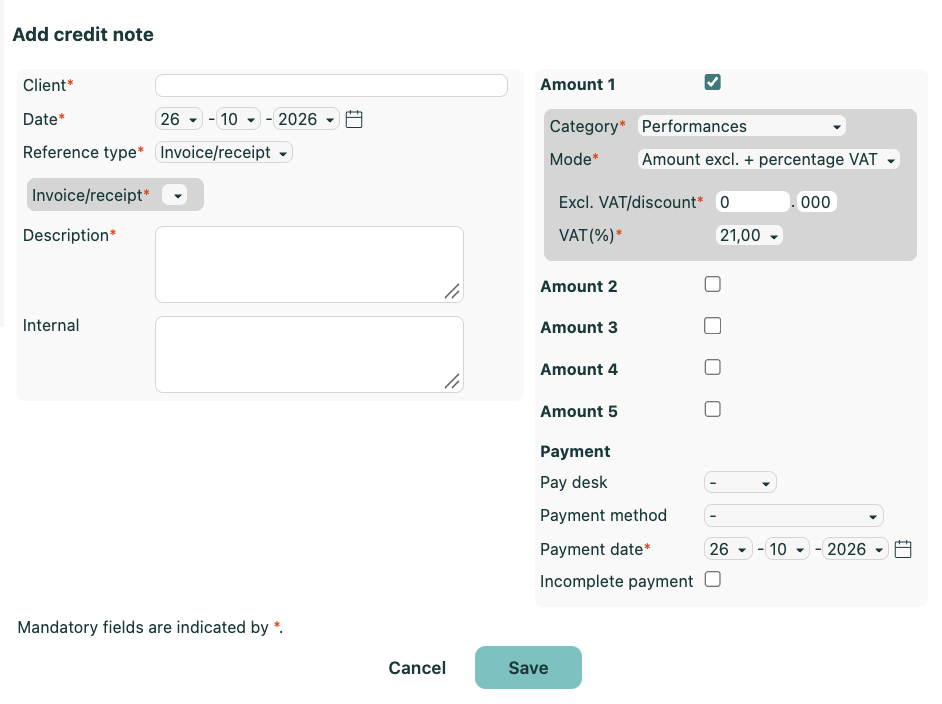
You can create a credit note via the Add credit note function under the Bookkeeping tab. You can also add a credit note directly in the client record under 'Financial'. A new screen appears, where you fill in the details of the credit note.
With a credit note you can fully or partly credit an invoice that has already been locked or checked out.
Looking up a credit note
To look up one or more credit notes, go to the Bookkeeping tab. In the bar below the main menu you see a dropdown menu and a search field. First select 'Credit note', then enter the exact search term or part of it. With an asterisk (*) as search term you get a list of all credit notes.

In the list of results, each credit note has shortcuts: you can for example directly edit the credit note, mark it as paid, download it or e-mail it. To open a credit note, click the 'Show' icon ( ). You can also get a list of all credit notes via the Credit notes report under the Bookkeeping tab.
Deleting a credit note
With the Delete credit note action you can delete a credit note.
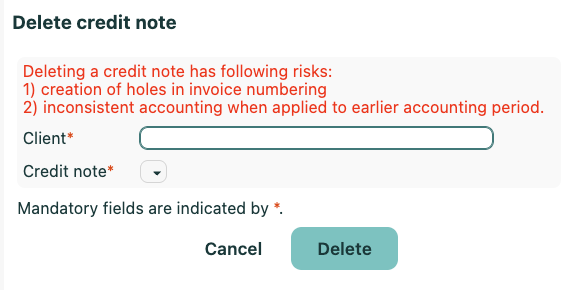
Invoices and credit notes share the same numbering. When you delete a credit note, Fuga does not reuse that number and a gap appears in the numbering.
⚠ Deleting is done at your own responsibility. Do not delete a credit note that was sent via Peppol or forwarded to an insurer. Returned products stay in stock after deleting. If in doubt, check with your accountant first. Sonetas is not responsible for the consequences in your accounting.
Before deleting, read the article Gaps in the invoice numbering: prevent, check and fill. It explains when you should not delete, how to correct the stock and the steps to fill the gap.
Unpaid credit notes
In the Bookkeeping tab you can call up the Unpaid credit notes report. Per row you can download or e-mail the credit note.
Settling an invoice (partly) against a credit note
When you have created a credit note from an invoice, you can mark the invoice as paid with payment method 'Credit note'. Then also settle the credit note with payment method 'Invoice'.
Three situations can occur:
- The credit note amount is smaller than the invoice amount: register a payment of type 'Credit note' on the invoice for the amount of the credit note. The outstanding balance of the invoice can be settled with another payment method. Settle the credit note fully with payment method 'Invoice'.
- The credit note amount equals the invoice amount: settle the full invoice with payment method 'Credit note' and the full credit note with payment method 'Invoice'.
- The credit note amount is greater than the invoice amount: you keep an outstanding part of the credit note, or you settle the credit note straight away by refunding the remaining balance (regardless of the payment method). The steps are in this article.
Please note:
When you create a credit note via the procedures above, ONLY financial movements are recorded. If you want to create a credit note because a client returns a product, follow the procedure in the article What do I do when a client returns a product?